



One Control Environment: Why Your SOC 2 Evidence Should Already Be Your CMMC Evidence
If you are collecting the same evidence more than once, you do not have only a compliance problem. You have an architecture problem.
Share this blog on:


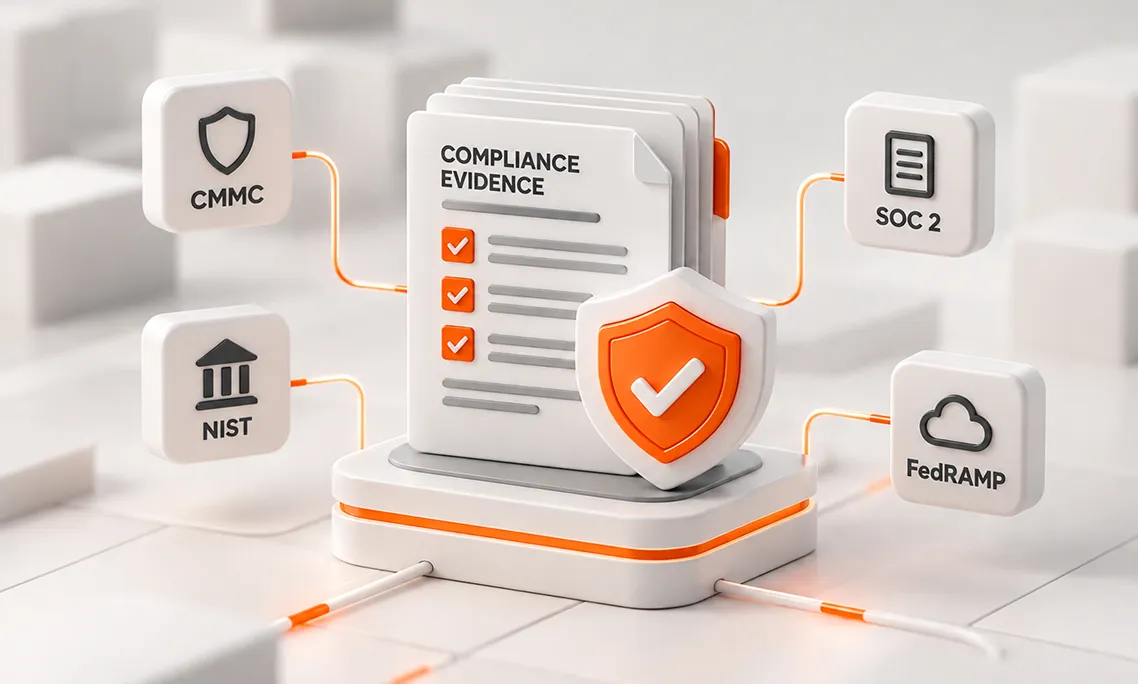
The same identity-management configuration should not live in one folder for SOC 2, another for CMMC, and a third for FedRAMP. The same access review, logging record, configuration baseline, or incident-response test should not be recreated every time a different assessor arrives.
SOC 2 evidence should already be part of your CMMC evidence environment. CMMC evidence should be structured so that it can support NIST, RMF, and, where applicable, FedRAMP work. That does not mean the frameworks are interchangeable or that an auditor must accept one report without additional analysis. It means the underlying control environment should be unified, traceable, and reusable.
That distinction matters.
A compliance automation platform can help you map controls, collect evidence, and monitor changes. It cannot decide your scope, determine whether a control is properly designed, or guarantee that an assessor will accept your evidence. The correct sequence remains:
- Audit your current environment.
- Build a remediation and evidence plan.
- Select tools that support that plan.
The tool comes third. Architecture comes first.
Tier 1: The Duplication Trap
How parallel compliance programs develop
Many organizations begin with one framework. A customer asks for SOC 2. A federal contract introduces NIST SP 800-171 or CMMC 2.0 readiness. A cloud service opportunity creates a FedRAMP requirement. A healthcare customer adds HIPAA. An enterprise buyer requests ISO 27001.
Each program often arrives at a different time, with a different executive sponsor, consultant, auditor, and deadline.
The result is predictable:
- A CMMC workbook maintained by the security or contracts team.
- A SOC 2 evidence folder owned by the compliance manager.
- A FedRAMP package managed by the cloud authorization team.
- A HIPAA binder maintained by legal or privacy staff.
- Separate policy repositories, evidence requests, control descriptions, and remediation plans.
These programs may all describe the same technology environment. Yet the organization treats them as separate businesses.
The identity provider is the same. The privileged-access process is the same. The ticketing system is the same. The SIEM is the same. The configuration-management process is the same.
But the evidence is requested three or four times.
The cost is more than duplicated labor
The obvious cost is time. Engineers answer repeated questionnaires. Managers approve repeated access reviews. Security teams export the same logs into different portals. Compliance staff rewrite the same control narrative using slightly different terminology.
The deeper cost is divergence.
Suppose your SOC 2 documentation says privileged access is reviewed quarterly. Your CMMC workbook says it is reviewed monthly. Your FedRAMP package describes an automated process but does not identify the system that performs it.
Which statement is true?
When one control is described differently in three documents, the organization loses its authoritative version of reality. Evidence may still exist, but confidence declines. The auditor must reconcile competing narratives. Your own team must investigate which document is current. A minor process change can leave one framework updated while the others remain stale.
This is how compliance becomes fragile.
A static folder may show that a control existed at one point in time. A unified control environment can show what the control is, who owns it, how it is implemented, what evidence supports it, and which frameworks depend on it.
That is a fundamentally different operating model.

Tier 2: Why the Overlap Is Real
The case for cross-framework reuse is not based on wishful thinking. The frameworks use different taxonomies and assessment methods, but their technical objectives overlap substantially.
NIST SP 800-171 and NIST SP 800-53 share a common foundation
NIST SP 800-171 Rev. 2 contains 110 security requirements across 14 families. It was developed from the broader NIST SP 800-53 control catalog, which also serves as the foundation for the Risk Management Framework and FedRAMP.
That relationship matters because it allows a properly structured control set to map upward.
You should not build one set of evidence for CMMC and a completely separate set for FedRAMP. You should identify the underlying security objective (such as controlling privileged access, reviewing audit events, or managing system changes) and then map that objective to the relevant requirements in each framework.
The frameworks are not identical. NIST SP 800-53 is broader and more detailed. FedRAMP includes additional requirements, agency considerations, inherited controls, and authorization-specific obligations. But the shared lineage creates a logical basis for reuse.
A well-designed control register maps across frameworks. It does not force the organization to work sideways from one spreadsheet to another.
SOC 2 uses a different taxonomy, but the functional overlap is significant
SOC 2 is organized around the AICPA 2017 Trust Services Criteria, with the 2022 Points of Focus. Its terminology differs from NIST’s control families, but its central objectives overlap with controls for:
- Logical and privileged access.
- Authentication and authorization.
- Change management.
- Risk assessment.
- Security monitoring.
- Incident response.
- Availability and resilience.
- Vendor and system oversight.
For example, a SOC 2 access-control test may examine user provisioning, deprovisioning, privileged accounts, and periodic access reviews. Those same operational records may support NIST and CMMC requirements related to account management, least privilege, and system access enforcement.
A SOC 2 change-management sample may include approved tickets, code-review records, deployment logs, and emergency-change documentation. Those artifacts may support configuration-management requirements under NIST SP 800-171 or NIST SP 800-53.
The evidence is not automatically accepted merely because it was prepared for SOC 2. CMMC assessors use CMMC-specific assessment expectations. NIST requirements may require more precise implementation descriptions, scope boundaries, or evidence tied to individual requirements.
But the underlying records should not need to be recreated.
CMMC Level 2 is directly tied to NIST SP 800-171 Rev. 2
CMMC Level 2 assesses against NIST SP 800-171 Rev. 2. The requirements are incorporated by reference through 32 CFR 170.14.
This is why a mature SOC 2 environment can provide useful raw material for CMMC 2.0 readiness. It may already include the identity controls, logging systems, change records, policies, risk registers, and incident documentation that CMMC requires.
However, “useful raw material” is the right phrase. A SOC 2 report does not replace a CMMC assessment. You still need to confirm:
- The relevant systems are in scope for CUI.
- The control is implemented in the CUI environment.
- The evidence covers the required period and assessment objectives.
- The system security plan accurately describes the environment.
- Gaps are documented rather than quietly treated as satisfied.
- Federal-specific obligations, such as DFARS incident reporting, are addressed.
CMMC Phase II third-party assessments are currently paused. That pause affects the timing and manner of independent verification. It does not eliminate the underlying obligations under DFARS 252.204-7012 or NIST SP 800-171.
The recent Honeywell settlement makes that distinction difficult to ignore. As Nixon Peabody reported, Honeywell Aerospace agreed to pay more than $2 million to resolve allegations involving NIST SP 800-171 failures. The case is a reminder that a pause in CMMC verification is not a pause in the duty to protect covered defense information or accurately represent your security posture.
FedRAMP 20x rewards structured evidence
FedRAMP 20x is moving toward machine-readable certification classes, identified as Classes A through D under the Consolidated Rules for 2026.
The model also moves away from legacy, manually maintained templates. Traditional artifacts such as the System Security Plan are being replaced or supplemented by structured security documentation, including the Security Decision Record. The direction is clear: authoritative information should come from structured sources and be capable of being updated, validated, and consumed by systems.
That shift has a practical consequence.
Organizations maintaining screenshots and static documents will find continuous verification difficult. Organizations that already collect structured evidence from identity systems, cloud platforms, ticketing systems, vulnerability scanners, and monitoring tools will be better positioned.
FedRAMP has also made Vulnerability Detection and Response and Vulnerability Evaluation and Reporting mandatory for applicable services effective December 7, 2026. FedRAMP Notice NTC-0014 explains the alignment with CISA Binding Operational Directive 26-04 and emphasizes that legacy monthly vulnerability scanning is insufficient for the new exposure- and threat-based approach.
A team that has automated evidence collection for NIST SP 800-171 and CMMC is not automatically FedRAMP 20x-ready. FedRAMP remains more demanding in important areas. But that team has an architectural advantage. It is already collecting evidence in a form that can be mapped, evaluated, and continuously updated.
Do not let renumbering destroy your evidence history
Framework revisions create another common failure mode: organizations prematurely rebuild their evidence structure around new identifiers.
NIST SP 800-171 Rev. 3 is the live example. It changes the structure from 110 requirements in Rev. 2 to 97 active requirements, adds families such as Planning, System and Services Acquisition, and Supply Chain Risk Management, and introduces organization-defined parameters that become assessable once assigned. NIST provides the Rev. 3 publication and change-analysis materials.
That does not mean you should immediately renumber every existing record.
Maintain a primary evidence index tied to the framework and revision under which you are currently assessed or contractually obligated. Then maintain a crosswalk to the successor revision. This preserves evidence history, avoids broken references, and lets you identify actual gaps rather than creating administrative gaps through renumbering.
Crosswalk first. Migrate when the governing contract, regulation, or assessment requirement requires it.
Generic compliance is now a quality risk
The same principle applies to SOC 2.
AICPA peer-review activity reported in 2026 has targeted high-volume, tool-driven SOC 2 practices that produce templated reports, identical risk assessments, identical sample sizes, and identical testing procedures across clients. Fortinetics’ summary of the AICPA peer-review crackdown describes structured monitoring that began June 1, 2026.
The lesson is not that automation is improper. The lesson is that generic automation cannot replace client-specific judgment.
Auditors are expected to test your environment. A SOC 2 automation tool can help collect evidence, but it cannot make every organization’s risk assessment, control design, sampling approach, or testing procedure identical.
A unified control environment is not a generic template. It is a structured representation of your actual architecture.
The Five Practical Moves
1. Build one control register, not one register per framework
Create one authoritative list of controls. Each control should include its owner, implementation description, scope, testing frequency, evidence sources, and mappings to every relevant framework.
One access-review control may map to SOC 2, CMMC, NIST SP 800-171, NIST SP 800-53, ISO 27001, and HIPAA. The control should exist once, with framework-specific views generated from that source.
2. Map once, then derive
Framework workbooks should be outputs of the control register, not separate projects.
If a customer asks for SOC 2 evidence, generate the SOC 2 view. If a contracting officer asks about CMMC readiness, generate the NIST and CMMC view. If a FedRAMP team needs a control narrative, derive it from the same implementation data and add the FedRAMP-specific requirements.
This is the practical meaning of “map once, satisfy many.”
3. Collect evidence at the source
Evidence should be attached to the control that it supports.
Use system APIs, scheduled collection, configuration exports, ticketing integrations, identity-provider data, vulnerability platforms, and monitoring systems wherever possible. A screenshot may be useful in certain situations, but screenshots should not be the default evidence architecture.
Source-based evidence is easier to timestamp, validate, update, and reuse. It also reduces the risk that a document outlives the configuration it describes.
4. Keep one evidence owner per control
Shared responsibility without a named owner usually becomes no responsibility.
Every control should have one accountable owner, even when several teams contribute evidence. The owner is responsible for confirming that the control remains implemented, the evidence remains current, and exceptions are escalated.
The compliance team can coordinate. It should not have to guess whether engineering, IT, legal, or operations owns the truth.
5. Crosswalk before you migrate
Do not renumber an existing evidence structure simply because a framework revision has been published.
Preserve your current index. Add successor mappings. Identify changed requirements and new obligations. Migrate when the contract or regulatory requirement demands it.
This approach protects continuity and makes it easier to explain how your evidence evolved over time.
Tier 3: How Complynt Supports One Control Environment
Complynt is H&V’s enterprise compliance automation platform for organizations managing overlapping regulatory requirements.
It supports automated control mapping, evidence collection, continuous monitoring, pre-built content packs, and policy-as-code. Complynt maps across more than 150 frameworks, including CMMC, NIST SP 800-171, NIST SP 800-53, RMF, SOC 2, FedRAMP, HIPAA, and ISO 27001.
That makes it suitable for the map-once-satisfy-many model described in this article. It can function as a SOC 2 automation tool, support NIST 800-53 compliance automation, and provide a foundation for FedRAMP compliance automation and automated compliance monitoring.
The platform runs on FedRAMP High and DoD IL5 authorized infrastructure on Palantir’s federal cloud. H&V is also EDWOSB certified, with experience supporting federal contractors, construction firms, facility operators, and complex facility-related control system environments.
But the platform is not the compliance process.
Complynt cannot determine whether your CUI scope is correct. It cannot decide whether your evidence proves implementation. It cannot issue a certification or guarantee a pass. Those judgments belong to qualified personnel and the applicable assessor or auditor.
That is why H&V recommends starting with an audit and a plan. Our free compliance readiness check can help you identify likely gaps and prioritize next steps, but it is not an official assessment or certification.
The question is simple: are you building separate compliance programs, or are you building one control environment that can support many obligations?
For federal contractors, CMMC readiness is not only about preparing a workbook. For cloud providers, FedRAMP compliance automation is not only about producing a package. For any organization pursuing SOC 2, the objective is not merely to fill an evidence folder.
The objective is to make your security program coherent enough that one truth can support every framework that depends on it.
Written by Josh Hammer